MIN Faculty
Facultyof Mathematics, Informatics
and Natural Sciences
and Natural Sciences
Photo: pixabay
14 July 2026, by MIN-Dekanat
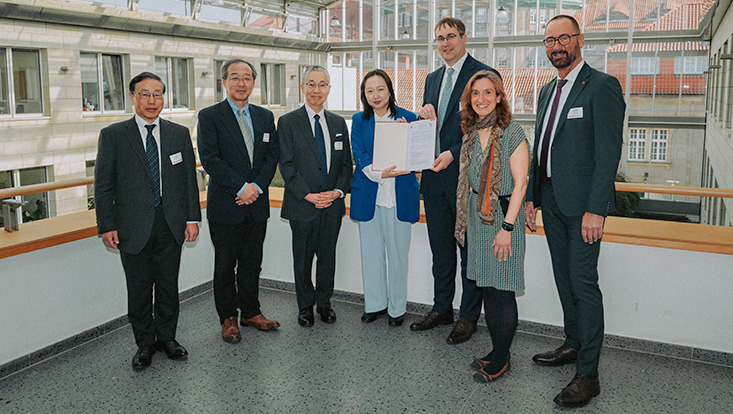
Photo: JACKZ Production
The signing of a Memorandum of Understanding between the University of Yamanashi (Japan) and the University of Hamburg (Germany) further expands international collaboration in the field of sustainable energy research. In addition to the planned joint master’s program, the new “Clean Energy Material Research Hub” was established to strengthen scientific collaboration between the two universities in the near future.
On the occasion of the visit of Prof. Xiaoyang Mao (Vice President & Executive Director for Research and Globalization Promotion of the University of Yamanashi) for the opening ceremony of the Japanese-European Clean Energy Material Research Hub, representatives of the MIN Faculty of the University of Hamburg and the University of Yamanashi exchanged views on the further enhancement of their partnership, which is based on the Memorandum of Understanding (MoU) on strategic cooperation signed in September 2025.
Prof. Dr.-Ing. Norbert Ritter (Dean of the MIN Faculty) underlines: “I am very pleased that our successful strategic collaboration with the University of Yamanashi is continuing to strengthen and that our students will soon benefit from it as well. This cooperation not only brings together the excellent research of our two countries in a highly relevant field, but now also complements it with excellent teaching in a joint degree program.”
Prof. Dr. Xiaoyang Mao (Vice President & Executive Director for Research and Globalization Promotion of the University of Yamanashi) underscores: “Our collaboration with Professor Özaslan's group at the University of Hamburg has made significant contributions to advancing research in this field, helping our university to be selected for the Japanese Ministry of Education, Culture, Sports, Science and Technology (MEXT)'s J-PEAKS (Program for Forming Japan’s Peak Research Universities) initiative, which supports universities with internationally recognized strengths in strategic research areas. Building on this achievement, we look forward to further strengthening our partnership. Energy is a global challenge, and international collaboration is therefore of paramount importance. Through this collaboration, we aim not only to promote cutting-edge research and technological innovation but also to foster student exchanges that enable young people to discuss energy issues across national borders, share ideas, and appreciate diverse perspectives.”
On the sidelines of the opening ceremony, working-level discussions were also held regarding a joint master degree program in chemistry with a focus on Materials Science.
“In the near future, it should be possible to complete part of the master’s program with a focus on energy materials for hydrogen and decarbonization technologies at the respective universities,” said Dr. Frédéric Hasché from the Technical Electrocatalysis Laboratory in the Department of Chemistry. “In this way, we are preparing our students from both countries for the global challenges of a sustainable society, guided by the motto ‘Global Thinking | Local Acting.’”
The new joint initiative between the MIN Faculty, University of Hamburg and University of Yamanashi is part of a series of activities in Hamburg aimed at further intensifying cooperation with Japan in the fields of hydrogen and future-oriented research. “Together with the renewal of the Memorandum of Understanding between the City of Hamburg and Fukushima Prefecture and the opening of the Japanese-European Clean Energy Material Research Hub at the University of Hamburg, Hamburg is increasingly developing into a place to be for future hydrogen and decarbonization technologies,” said Prof. Dr. Mehtap Özaslan from the Technical Electrocatalysis Laboratory, Department of Chemistry. “This provides us with a wide range of opportunities and new stimulus for research, technology transfer to industry, and, of course, cultural exchange between our countries.”
Prof. Dr. Katsuyoshi Kakinuma (Clean Energy Research Center/Hydrogen and Fuel Cell Nanomaterials Center, University of Yamanashi) points out: “The international society requires the wide spread use of the hydrogen toward the generation of global “green energy society”. Our researchers are expected to dramatically enhance the performance of the hydrogen technologies. The international collaboration in our top-level researches between Japan and Europe generates the new development and innovation through mutual synergy and harmony.”
Prof. Dr.-Ing. Norbert Ritter summarizes the exchange with the Japanese delegation from the University of Yamanashi as follows: “The University of Excellence Hamburg and the University of Yamanashi—which has received a similar distinction in Japan as part of the local J-PEAKS program—are pooling their scientific expertise in the currently highly relevant and promising field of hydrogen and decarbonization technologies. The establishment of the Japanese-European Clean Energy Material Research Hub at the University of Hamburg will further strengthen this outstanding international collaboration.”