MIN Faculty
Facultyof Mathematics, Informatics
and Natural Sciences
and Natural Sciences
Photo: pixabay
26 May 2026, by MIN-Dekanat

Photo: UHH/MIN
An international research team led by a research group at the University of Hamburg has, for the first time, experimentally demonstrated that so-called Majorana states in atomically fab-ricated magnetic chains of atoms are remarkably robust. The findings provide experimental evidence for the theoretically predicted topological protection of these quantum states and open up new prospects for future quantum computers. The researchers report their findings in the journal “Nature Physics”.
Quantum computers are regarded as a key technology of the future – yet their development has so far been limited by the high error rate of qubits. Qubits are the computational units of quantum computers and, unlike conventional computers, can exist in both the 0 and 1 states simultaneously, enabling certain computational tasks to be solved significantly faster than with conventional computers.
The research team from Germany, Finland, Japan and Australia has demonstrated that these exotic quantum states remain stable even when the material exhibits electronic disorder and at relatively high temperatures of 4.2 Kelvin. This is remarkable, as today’s quantum bits typically require temperatures below 1 Kelvin and are extremely sensitive to structural defects.
For years, Majorana states have been regarded as a promising basis for so-called topological quantum computers. These utilise special quantum states that are thought to be significantly more robust against external disturbances and defects in the material than conventional qubits.
The theoretical foundations for Majorana particles were laid more than 90 years ago by the Italian physicist Ettore Majorana. Whilst the search for them in high-energy physics continues to this day, evidence of so-called Majorana quasiparticles has been observed in solid-state systems in recent years. The new results from Hamburg now provide experimental confirmation of their robustness – a key prerequisite for their use in fault-tolerant quantum computers.
“Unlike many other research approaches – such as those involving semiconductor-superconductor hybrid systems – we investigated magnetic atomic chains constructed with atomic precision on superconducting materials,” says Roland Wiesendanger, Professor in the Department of Physics at the University of Hamburg and a principal investigator of the Cluster of Excellence ‘CUI: Advanced Imaging of Matter’. “In recent years, this has led both to the detection of novel topological superconducting states – a prerequisite for the existence of Majorana particles – and to a ‘smoking-gun’ experiment confirming the existence of exotic Majorana quasiparticles.”
The recently published study opens up new avenues for the development of robust Majorana qubits and could, in the long term, pave the way for more stable hardware architectures in future quantum computers.
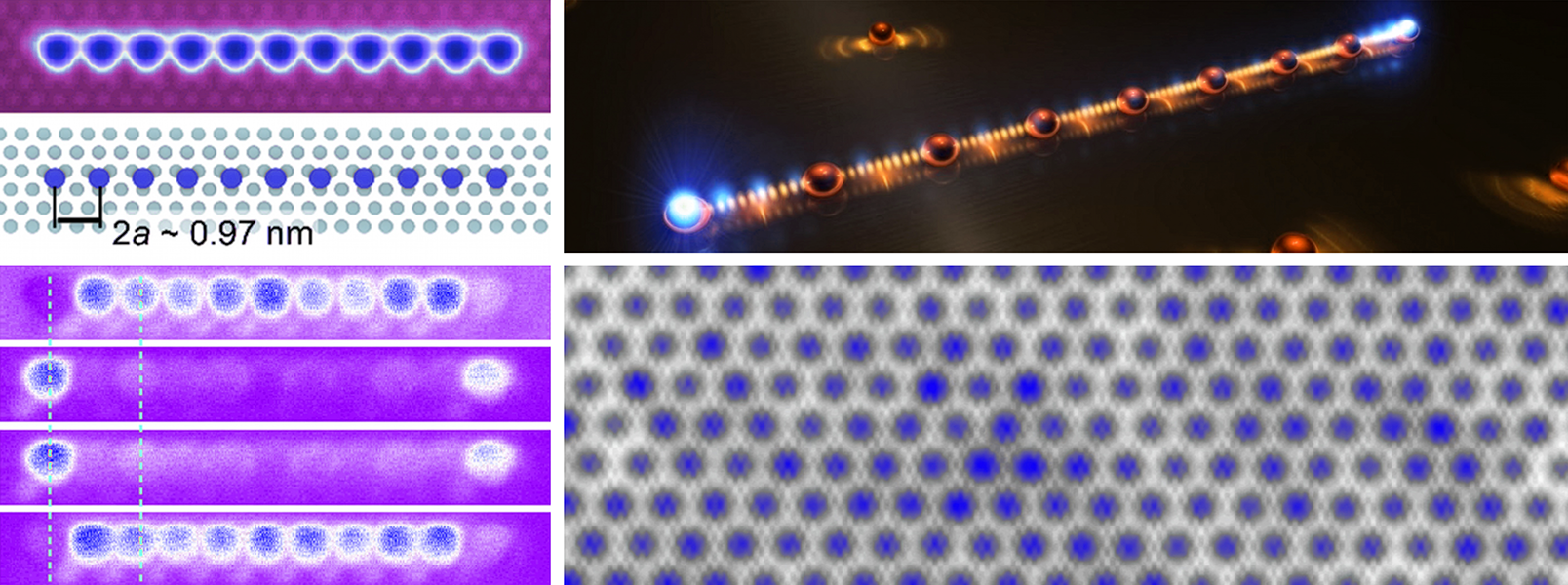
Visual materials: A linearly arranged chain of eleven magnetic iron atoms on a superconducting substrate, fabricated with atomic precision and imaged using a scanning tunnelling microscope. Under suitable conditions, so-called Majorana quasiparticles form at the ends of the chain. The study demonstrates for the first time that these states remain robust despite nanoscale surface disorder.
Harim Jang, Daniel Crawford, Khai That Ton, Lucas Schneider, Jens Wiebe, Makoto Shimizu, Harald O. Jeschke, Stephan Rachel and Roland Wiesendanger:
Robustness of Majorana modes to a disorder potential in atomic chains on a superconducting Rashba alloy,
Nature Physics (2026).