MIN Faculty
Facultyof Mathematics, Informatics
and Natural Sciences
and Natural Sciences
Photo: pixabay
25 February 2026, by MIN-Dekanat
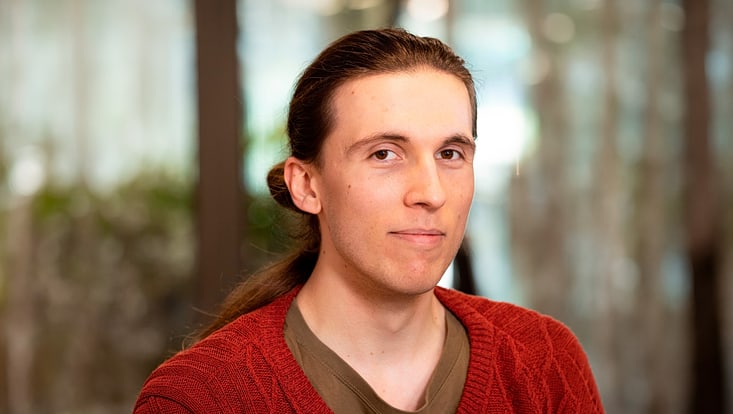
Photo: Mikael Wallerstedt/Adobe Firefly
Since the end of 2025, Mateusz Stroiński has been conducting research on higher representation theory at the Department of Mathematics at the University of Hamburg. Funded by a scholarship from the Knut and Alice Wallenberg Foundation, he has relocated his research to the Elbe and will be working in the Hanseatic city until 2027. In this interview, he talks about his scientific plans, new perspectives and his arrival at the University of Hamburg.
Mateusz Stroiński, you work in the field of higher representation theory. Can you explain what your research is about?
I study mathematical objects that have structure on multiple layers of sophistication. Traditionally, algebra consists of elements and rules for combining them. In more modern approaches, those elements are themselves allowed to transform. The objects I‘m studying allow elements to both combine and transform in a compatible way. Over recent decades, this kind of structure has found applications not only in mathematics but also in physics.
Can you give an example?
Think of the board game Risk. You have a map divided into territories and each players has an armie. Players cann recruit new units, move them around, and let them fight. In this sense, they are able to both combine units and transform them through movement, upgrades, or combat. I think it’s this idea that is somehow crucial in the research that I've been doing.
How did you choose this research field?
My master’s thesis advisor gave me several topics to choose from, and one of them was this fancy and modern sounding thing. Frankly, I’d like to say there was a profound reason, but honestly, it started with a somewhat random choice. Sometimes, the first step is often a silly story, right?
What is the goal of your research?
Mathematicians are naturally cautious people. It would be irresponsible to say, “My goal is to prove this specific conjecture,” because because you're constantly facing the risk that the conjecture is not true. For me, the goal is twofold.
First, Hamburg has a strong focus on connections between mathematics and mathematical physics, especially applications to theoretical physics, and this is something I really wanted to explore further.
Second, I want to establish results that are not only important within my own field, but that also contribute to other areas of mathematics or physics.
You mentioned the connection between mathematics and physics. Is this something you focus on during your stay in Hamburg?
Yes. One aim of connecting mathematics and physics is to use mathematics to better understand physical phenomena. Interestingly, one can also use ideas from physics to gain insight into mathematics. As a pure mathematician, I find this perspective very appealing.
Many people feel that mathematics is a finished subject, unlike physics, where the universe is constantly expanding. How do you see this?
This is one of the fun experiences that mathematics students learn roundabouts the masters level: one learns to formulate statements so sophisticated that the probability of ever proving them may be close to zero. So in mathematics is not only the art of attacking problems, it's also choosing the problems that are even within reach.
Is that what you like about mathematics? Is that why you chose it?
Yes, I definitely enjoy that aspect, and it’s something I want to get better at. I work with senior collaborators who have an impressive ability to navigate ideas on a broad level, while I tend to focus more on technical details. I like to think of it as being the mechanic working with a Formula One driver — but at some point, you also want to switch seats in the collaboration.
Why did you become a researcher in the first place?
This may sound underwhelming, but I pursued a PhD in mathematics partly because I failed to become a high school teacher. I did seriously considermathematics and becoming a resdearcher, but my choice was simplified by the fact that I didn’t have sufficient proficiency in Swedish. I was born in Poland and lived there until I was thirteen.
Now you are in Hamburg, how do you like it here?
Whenever I have time to walk around and take in the atmosphere of the city and I really enjoy it. So far, I like Hamburg a lot.
Mateusz Stroiński’s research is supported by two foundations: Between 1st of September and 31st of December 2025, he was supported by the Lundström-Åmans stipendiestiftelse, and from the 1st of January 2026 (until 31st of December 2027), he is supported by the Knut and Alice Wallenberg Foundation. The Knut and Alice Wallenberg Foundation’s aim is to benefit Sweden by supporting Swedish basic research and education, mainly in medicine, technology, and the natural sciences by supports long-term, free basic research.